Attribution Creative Commons Noncommercial No Derivatives Share Alike Zero

Samsung Calculator Secret Codes -

The official Samsung Calculator app hides more than just math. Beyond standard calculations, you can access hidden diagnostic modes and factory testing tools through specific string sequences. The Master Diagnostic Code

  • Code to type: *#0*#
  • Where to type: Enter this into the calculator keypad (in Converter mode).
  • Result: Instantly launches a grey diagnostic screen with colored buttons (Red, Green, Blue, Touch, Vibration, etc.).
  • ⚠️ Warning: Do not tap “Sensor” or “Touch” unless you want to run a test. To exit, simply press the Volume Down button or tap the back button repeatedly.

Hidden in Plain Sight: The Secret Codes Hidden in Your Samsung Calculator

This is more common on Galaxy S and Note series devices specifically set up as retail demo units. It allows sales staff to cycle through feature demonstrations without crashing the app. samsung calculator secret codes

The first message was practical. 12-9-187 = OPEN. It gave her an address a few blocks from the shop, a rowhouse whose stoop was crowned with a brass lion. Inside lived an old woman named Rosemary who kept jars of pickled cherries and photographs that smelled faintly of smoke. She had a key for a box that contained—Mina expected a map or a letter—an odd collection: subway tokens from cities Mina had never visited, a bus ticket clipped to a postcard of a lighthouse, and a strip of paper with more of the calculator’s number-lines: 3.14159… folded into a note that read, "For when you need to remember why." The official Samsung Calculator app hides more than

Mina started to dig. The calculator, she discovered, spoke three kinds of code: arithmetic sequences that scrolled instructions, trigonometric lines that mapped to coordinates, and a kind of numerical poetry built from prime numbers and factorials. Each set of numbers unlocked another mode of the app, and each mode revealed a story stamped into the phone by its previous owner—a person who had loved puzzles enough to slant their life into them. Code to type: *#0*# Where to type: Enter
Unlocking Hidden Features: Samsung Calculator Secret Codes

Fig. 1. — Brigade KGK (Viktor Koretsky [1909–98], Vera Gitsevich [1897–1976], and Boris Knoblok [1903–84]). “We had to overcome among the people in charge of trade the unhealthy habit of distributing goods mechanically; we had to put a stop to their indifference to the demand for a greater range of goods and to the requirements of the consumers.” From the 16th to the 17th Congress of the All-Union Communist Party (Bolsheviks), 1934, no. 57, gelatin silver print, 22.7 × 17 cm. Los Angeles, Getty Research Institute, 2014.R.25.
Fig. 2. — Brigade KGK (Viktor Koretsky [1909–98], Vera Gitsevich [1897–1976], and Boris Knoblok [1903–84]). “There is still among a section of Communists a supercilious, disdainful attitude toward trade in general, and toward Soviet trade in particular. These Communists, so-called, look upon Soviet trade as a matter of secondary importance, not worth bothering about.” From the 16th to the 17th Congress of the All-Union Communist Party (Bolsheviks), 1934, no. 56, gelatin silver print, 22.7 × 17 cm. Los Angeles, Getty Research Institute, 2014.R.25.
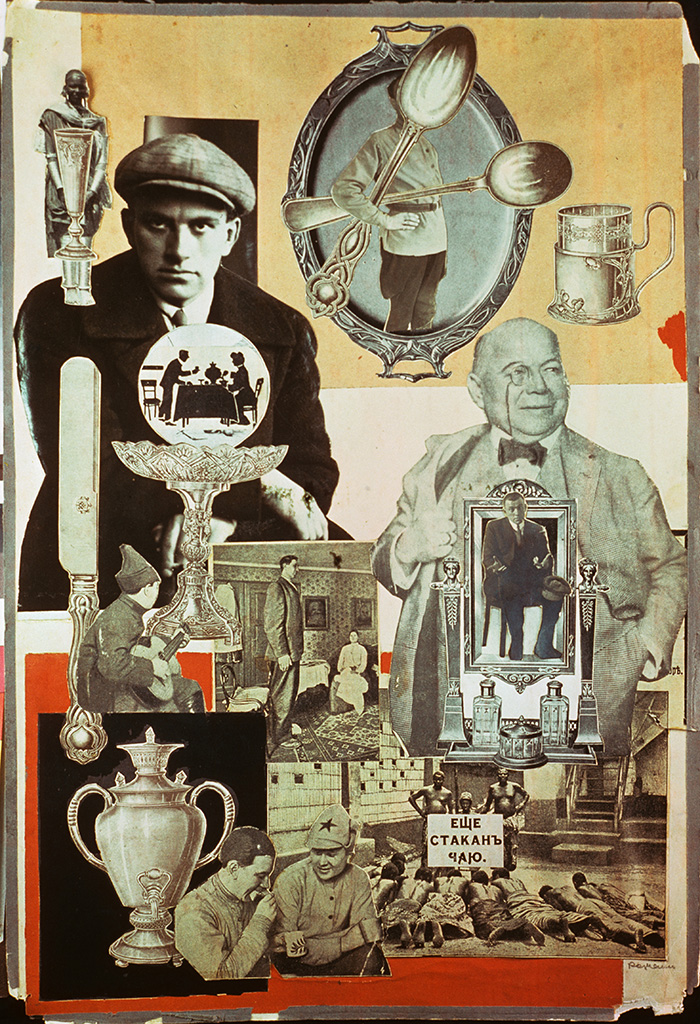
Collage of photographs showing Vladimir Mayakovsky surrounded by a silver samovar, cutlery, and trays; two soldiers enjoying tea; a giant man in a bourgeois parlor; and nine African men lying prostrate before three others who hold a sign that reads, in Cyrillic letters, “Another cup of tea.”
Fig. 3. — Aleksandr Rodchenko (Russian, 1890–1956). Draft illustration for Vladimir Mayakovsky’s poem “Pro eto,” accompanied by the lines “And the century stands / Unwhipped / the mare of byt won’t budge,” 1923, cut-and-pasted printed papers and gelatin silver photographs, 42.5 × 32.5 cm. Moscow, State Mayakovsky Museum. Art © 2024 Estate of Alexander Rodchenko / UPRAVIS, Moscow / ARS, NY. Photo: Art Resource.
Fig. 4. — Boris Klinch (Russian, 1892–1946). “Krovovaia sobaka,” Noske (“The bloody dog,” Noske), photomontage, 1932. From Proletarskoe foto, no. 11 (1932): 29. Los Angeles, Getty Research Institute, 85-S956.
Fig. 5. — Brigade KGK (Viktor Koretsky [1909–98], Vera Gitsevich [1897–1976], and Boris Knoblok [1903–84]). “We have smashed the enemies of the Party, the opportunists of all shades, the nationalist deviators of all kinds. But remnants of their ideology still live in the minds of individual members of the Party, and not infrequently they find expression.” From the 16th to the 17th Congress of the All-Union Communist Party (Bolsheviks), 1934, no. 62, gelatin silver print, 22.7 × 17 cm. Los Angeles, Getty Research Institute, 2014.R.25.
Fig. 6. — Brigade KGK (Viktor Koretsky [1909–98], Vera Gitsevich [1897–1976], and Boris Knoblok [1903–84]). “There are two other types of executive who retard our work, hinder our work, and hold up our advance. . . . People who have become bigwigs, who consider that Party decisions and Soviet laws are not written for them, but for fools. . . . And . . . honest windbags (laughter), people who are honest and loyal to Soviet power, but who are incapable of leadership, incapable of organizing anything.” From the 16th to the 17th Congress of the All-Union Communist Party (Bolsheviks), 1934, no. 70, gelatin silver print, 22.7 × 17 cm. Los Angeles, Getty Research Institute, 2014.R.25.
Fig. 7. — Artist unknown. “The Social Democrat Grzesinski,” from Proletarskoe foto, no. 3 (1932): 7. Los Angeles, Getty Research Institute, 85-S956.
Fig. 8A. — Pavel Petrov-Bytov (Russian, 1895–1960), director. Screen capture from the film Cain and Artem, 1929. Image courtesy University of California, Berkeley, Berkeley Art Museum and Pacific Film Archive Library.
Fig. 8B. — Pavel Petrov-Bytov (Russian, 1895–1960), director. Screen capture from the film Cain and Artem, 1929. Image courtesy University of California, Berkeley, Berkeley Art Museum and Pacific Film Archive Library.
Fig. 8C. — Pavel Petrov-Bytov (Russian, 1895–1960), director. Screen capture from the film Cain and Artem, 1929. Image courtesy University of California, Berkeley, Berkeley Art Museum and Pacific Film Archive Library.
Fig. 9. — Herbert George Ponting (English, 1870–1935). Camera Caricature, ca. 1927, gelatin silver prints mounted on card, 49.5 × 35.6 cm (grid). London, Victoria and Albert Museum, RPS.3336–2018. Image © Royal Photographic Society Collection / Victoria and Albert Museum, London.
Fig. 10. — Aleksandr Zhitomirsky (Russian, 1907–93). “There are lucky devils and unlucky ones,” cover of Front-Illustrierte, no. 10, April 1943. Prague, Ne Boltai! Collection. Art © Vladimir Zhitomirsky.
of